Background
Dr. Milind V. Rane, an Indian inventor, was a freelance consultant when he conceived and developed the design for the Matrix Heat Recovery Unit (MHRU). The invention relates to a heat exchanger – an innovative compact design to heat fluids using “waste” heat from exhausts and can be used to heat a variety of fluids. It can recover heat from hot gases and/or vapors from engines, gensets, boilers or furnaces. Heat is recovered in the form of steam, hot water or hot thermic fluid.
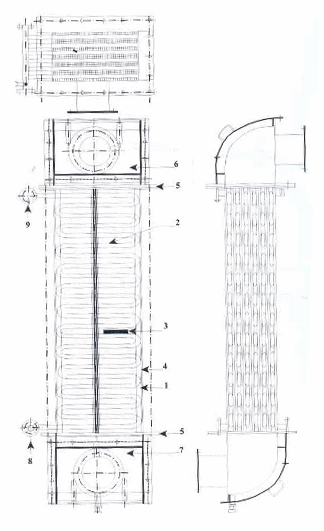
The MHRU is patented with the Indian patent office
Invention
“Thermodynamics tells us that if we want to cool a substance, we need to remove heat for which we have to do work. Now this 'waste' heat which we have extracted can in turn be used to produce heating,” says Dr. Rane. The concept of the MHRU is based on this logic and was motivated by the need to develop a heat recovery unit to address certain limitations of the prior art (shell and tube configuration with gas or water tube designs). The inventive step of the MHRU was the combination of at least two sets of heat transfer passages encapsulated in a conducting matrix, wherein one of the sets carries hot gases and the heat recovery fluid passes through the other set. Dr. Rane’s invention scores over conventional designs in terms of compactness, safety and flexibility. Additionally, the costs of the MHRU are 20 to 25% lower than that of conventional designs.
Partnerships and Licensing
In the late 1990s, Dr. Rane was introduced to Unidyne Energy Environment Systems Pvt. Ltd. by one of his friends. Unidyne is a small-scale company, based in Mumbai and engaged in the manufacturing and sale of direct waste heat fired boilers and various industrial thermal energy systems. Following a demonstration of the invention to the company, Dr. Rane signed a Memorandum of Understanding (MoU) with Unidyne by which a license was granted to Unidyne to manufacture and sell the MHRUs as engine exhaust fired steam generators and water and thermic heaters.
As per the MoU, a down payment was made at the time of signing, and subsequent payments were made after achieving various milestones during the demonstration phases. The agreement stipulated a royalty rate of 4.5% of net sales for the inventor.
For Unidyne, the MoU represented an important move as it enabled the company to enhance its product portfolio and widen its technology and customer base. For the inventor, the license provided a vehicle for the commercialization of the invention.
Patents
A provisional patent for MHRU was filed in India in 1999 after the successful demonstration of the invention to Unidyne. The invention was licensed on the basis of this patent application and the costs of patent filing and maintenance were borne by Unidyne.
The first examination report was received from the Indian patent office in early 2004. The patent agent was changed mid course and the patent specification and claims had to be amended. After a hearing at the patent office and a few office actions with the patent examiner, the patent was granted in October 2004. The patent was not assigned to Unidyne, but it was agreed that the technology would not be licensed to any other company in India as long as a minimum royalty payment schedule is met.
Since this was the inventor’s first exposure to the patent system, and since there was a lack of adequate initial guidance, for this invention a patent application was only filed in India. The priority period of 12 months lapsed without filing patent applications abroad. With hindsight, this proved to be a mistake, as the market for the MHRU extends beyond the national boundaries.
Amending the claims to the patent specification during the patent prosecution stage was an important step to be able to effectively protect the invention. Interactive sessions with the patent agent have also opened up new avenues, and the inventor has now filed Indian as well as PCT applications for several other inventions, some of which are already in the process of being licensed for commercialization.
Commercialization and Business Results
Following the signing of the MoU, even before a patent was granted for the invention, as many as 45 MHRUs were installed in various companies in India. Initially, MHRUs were marketed through Unidyne’s existing network. Subsequently, an original equipment manufacturer (OEM) contract was signed with Cummins Diesel Sales and Services (CDSS).
Revenues generated from the down payment and the royalties have helped for the development of other inventions. Dr. Rane has continued his R&D work, and a number of new technologies and products have already been developed, while many others are being developed:
Developed Technologies/Products
- Multi-Utility Heat Pumps
- Superheat Recovery Water Heater
- Solar Air Heaters
- Recuperator for Micro Gas Turbine
- Hybrid Air Conditioning System
- Liquid Desiccant System for Fresh Air De-humidification
- Exhaust Heat Fired Absorption Refrigeration System
- Radiant Heat Pump for Heating & Cooling
- Thermo Electric Headgear for Comfort
Products being Developed
- Shipboard Chilling System
- Plastic Solar Dryer
- Solar Refrigerator cum Water Heater
- Solar Indoor Cooker with Storage
- Solar Steam Generator
- Truck Exhaust Fired Refrigeration System
- Ammonia/Water Vapor Compression Heat Pump
- Pulsating Heat Pipes
- Biogas Cleaning and Bottling
Dr. Rane has won a number of awards, including the VASVIK AWARD 2005 for his research contributions in the development and deployment of the MHRU and related work.
From Concept to Commercialization: Benefits of the Patent System
The process leading to commercialization of the MHRU was an eye-opener for Dr. Rane on the potential benefits that can result from effective use of the patent system. Although joint efforts between the inventors and firms in intellectual property development have many advantages, benefits sharing can be an area where disputes can arise if contentious issues are not sorted out before work is started. The collaboration between Dr. Rane and Unidyne shows that these issues can be resolved through proper contract responsibilities and obligations.